You need 2,000-word articles every week, and your current tool keeps stalling at the outline. Many platforms cap output length, charge extra for bulk generation, or bury you in credits before a draft is finished. That friction is exactly why people start hunting for alternatives.
This article breaks down 8 Content at Scale alternatives built for long-form SEO, starting with Autoblogging.ai as the best overall pick. You will see how each tool handles word count, pricing, and bulk workflow so you can match one to your blog, agency, or client pipeline before you commit.
What to Look For in Content at Scale Alternatives for Long-Form SEO
When evaluating Content at Scale alternatives for long-form SEO, you need to look beyond basic article generation and consider factors like content depth, SEO optimization, scalability, and integration capabilities. A tool that produces a polished 800-word blog post may fall apart when asked for a 3,000-word pillar page that needs to rank.
The criteria below act as a practical checklist. Not every tool needs to ace every category, but knowing where each one is strong helps you match software to your actual workflow instead of chasing feature lists.
Long-form capability sits at the top of the list. Many AI writing tools handle short posts well but lose coherence past the 1,500-word mark, repeating points or drifting off topic. Look for platforms designed to hold structure across multiple sections and headings.
SEO features matter just as much. Keyword optimization, SERP analysis, and content briefs separate a generic generator from a tool built for search. Without them, you are publishing content that reads fine but competes poorly.
AI model quality shapes output directly. Tools built on advanced large language models like GPT-4 tend to produce more natural phrasing and better handling of nuance than older engines. The underlying model affects everything downstream.
Bulk generation determines whether the tool fits your publishing volume. If you manage several sites or client accounts, producing one article at a time becomes a bottleneck fast.
Integration keeps your workflow connected. Direct publishing to WordPress, automation through Zapier, and export options reduce manual steps between draft and live post.
Pricing should match your output. Per-article credits, monthly subscriptions, and unlimited plans suit very different users, so compare cost against realistic monthly volume rather than headline rates.
Output quality is the final filter. Human-like tone, logical flow, and freedom from repetition are non-negotiable for content you plan to publish under your own brand.
Support and updates indicate whether the tool will keep pace with search and model changes. A vendor that ships regular improvements is a safer long-term bet than one that goes quiet.
Weigh these factors against your own priorities. A solo blogger may rank integration and price highest, while an agency might care most about bulk generation and SERP-driven briefs. The right Content at Scale alternative is the one that matches how you actually work.
1. Autoblogging.ai - Best Overall
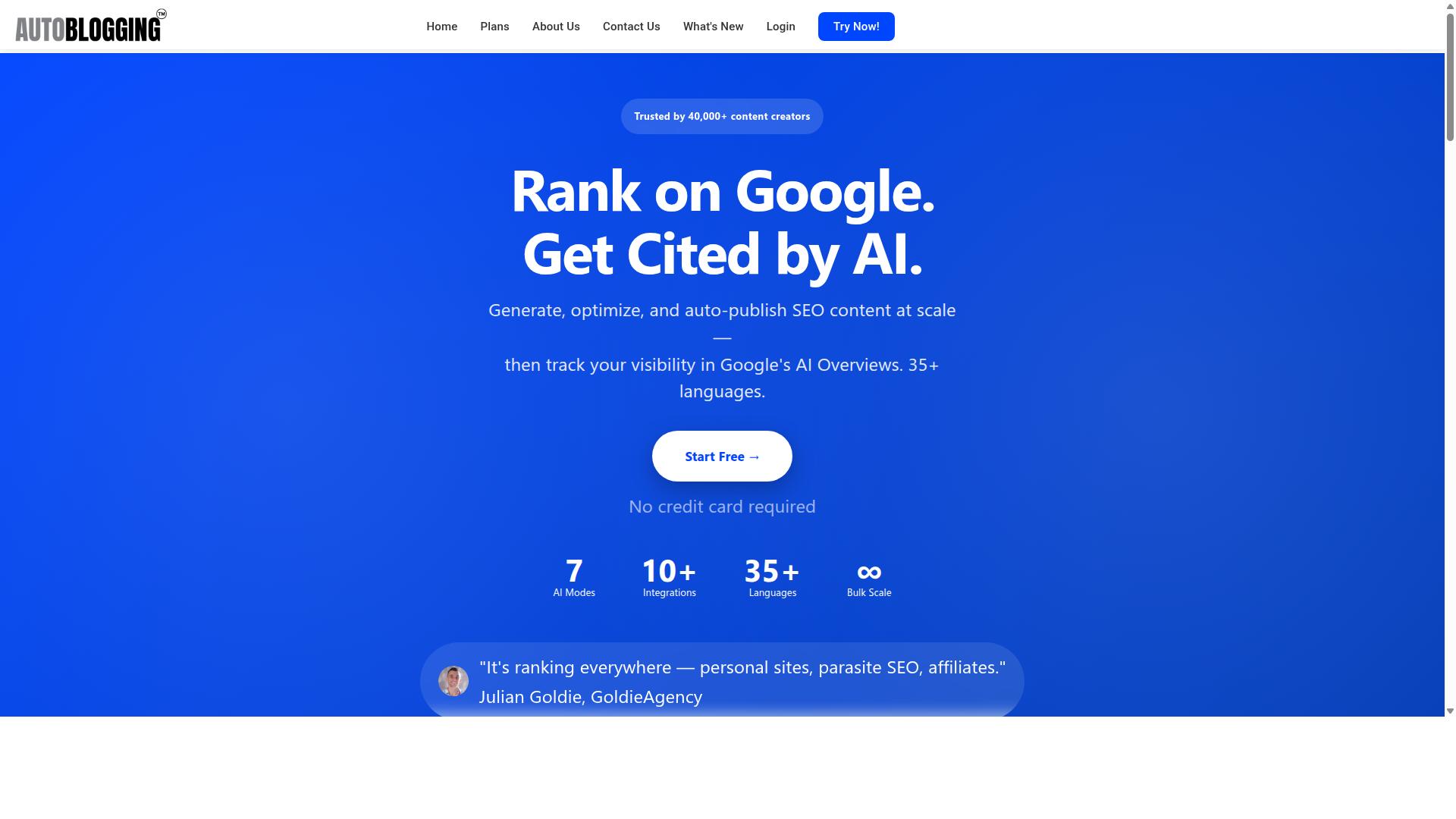
Autoblogging.ai has quickly become a top choice for content creators seeking a powerful Content at Scale alternative, thanks to its advanced AI modes and robust long-form capabilities.
Built by Digimetriq.com, the platform is trusted by 40,000+ content creators and holds a 4.9 average rating, with more than 1M articles generated to date. It is available globally and designed to help bloggers, site owners, and agencies save time while improving their online presence.
For teams producing long-form SEO articles at volume, that combination of reach and reliability makes it a strong first stop in this roundup.
Key Features, Pricing, and Long-Form Capabilities
Autoblogging.ai offers a range of features tailored for long-form SEO, including its Godlike Mode that analyzes SERP competitors and extracts LSI keywords and knowledge graphs.
That mode matters for long-form work because semantic depth is what separates a ranking article from a thin one. By pulling competitor signals and entity relationships into the draft, the tool supports the kind of topical coverage that search engines reward.
Other core capabilities include:
- Quick Mode, which is free and available in single and wizard formats
- Bulk Generation, producing up to 500 articles via CSV
- 10+ AI modes, including News Mode and Amazon Reviews Mode
- 35+ languages and 35+ integrations
Publishing options span WordPress (unlimited sites, one-click, plugin, scheduled auto-posting), Web 2.0 platforms like Medium, Dev.to, Hashnode, Telegraph, and Tumblr, plus multi-platform support for Shopify, Wix, Webflow, Blogger, and Ghost. An API, Zapier, and n8n round out the integration layer.
Optimization tools include Site Optimizer, Semantic SEO Analysis (a 21-point audit), Snippet Optimizer, Topical Maps, Intense Optimizer, Fan Out Queries, AI Infographics, Outreach Prospects, AI Proofreader, and Human Proofreader. A Content Repurposer and Done For You packages are also available.
Pricing runs on monthly plans from Starter at $19 (40 credits) up to Enterprise at $999 (5,000 credits), with annual options and credits rollover. Support is available 24/7, new features ship weekly, and human proofreading adds a final quality layer before publishing.
2. Agility Writer
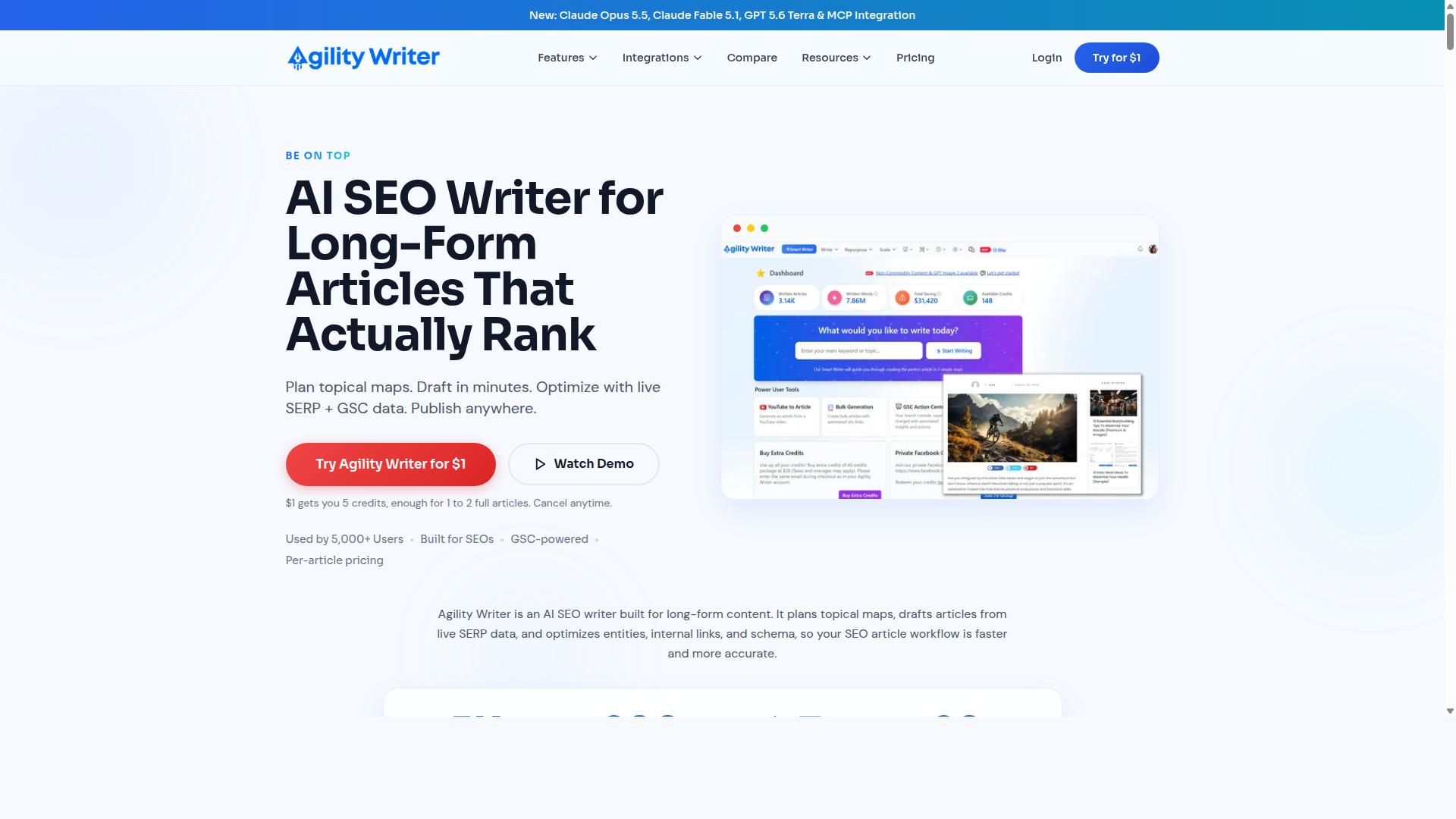
Agility Writer is a relatively new AI writing tool that focuses on generating long-form content with a user-friendly interface and competitive pricing. It has positioned itself as an SEO-first platform, meaning the article generation workflow is built around search intent and SERP data rather than generic text output.
For teams comparing Content at Scale alternatives, Agility Writer is worth a closer look because it blends draft generation with optimization features in a single dashboard. It is aimed primarily at SEO-focused content creators and affiliate marketers, two groups that need volume without sacrificing on-page relevance.
Its feature set covers the core needs of a long-form workflow, from planning through publishing:
- Long-form drafting powered by live SERP data, with support for blog posts, product reviews, and roundup reviews
- Topical map planning to organize clusters of related articles around a pillar topic
- Templates and writing modes for different content formats and tones
- Smart Writer and Smart Editor for drafting and refining sections
- Fact Sheets to keep claims grounded in source material
- G-Smart Optimizer and Topical Authority Audit for on-page and site-level SEO checks
- Bulk Generation for producing multiple drafts in one pass
- GSC Action Center for working from Search Console signals
- Smart Visual AI and Social Posts for supporting assets
- Integrations with Claude, ChatGPT, Cursor, WordPress, API, and Zapier
Agility Writer also states that its output aligns with Google's Helpful Content Update, which matters for anyone publishing at volume. The platform offers a $1 trial with 3 credits for 3 articles, and there is no free trial beyond that entry point. That low-cost entry makes it easy to evaluate whether the writing style fits your editorial standards before committing further.
On the plus side, the tool is generally described as easy to use and affordable relative to many enterprise-grade platforms. The template variety and built-in optimization checks reduce the number of separate tools a writer needs to juggle.
There are tradeoffs to weigh. Some users report that integrations feel limited compared to larger suites, and output quality can be inconsistent across topics, particularly in niche or highly technical subjects. As with any AI writing tool, editing and fact-checking remain necessary before publishing.
Compared to Content at Scale, Agility Writer targets a similar long-form use case but leans harder into SEO workflow features like topical maps and Search Console actions. Content at Scale is often chosen for very high-volume production, while Agility Writer appeals to creators who want planning and optimization bundled with drafting. For long-form SEO articles, both can work, but the better fit depends on whether you prioritize raw output volume or an integrated SEO pipeline.
3. SEOWriting.ai
SEOWriting.ai is an AI-powered writing assistant that emphasizes SEO optimization, allowing users to generate articles optimized for search engines with a single click. It sits in the same broad category as Content at Scale, targeting marketers and site owners who need a steady flow of long-form SEO articles without building a full editorial pipeline.
Its core appeal is speed and simplicity. Rather than walking through a lengthy setup, users can move from a keyword or topic to a finished draft quickly. That one-click generation approach makes it accessible to people who are new to AI writing tools.
SEOWriting.ai also offers a WordPress integration, which lets users push generated content toward their site with less manual copying and pasting. For teams managing multiple blogs, that auto-posting flow can reduce friction between drafting and publishing.
Multi-language support is another part of its positioning. Users working across more than one market can generate articles in different languages, which helps when a single site serves several regions or audiences.
A free plan is available, and it offers 3 free articles up to 25,000 words. That gives newcomers a low-risk way to see whether the output style fits their needs before committing further.
On the strengths side, SEOWriting.ai leans heavily into search-focused output. Its emphasis on SEO optimization means drafts often arrive with structure that aligns to common on-page patterns, which can save time during editing. The tool is also positioned for bulk article generation, so it suits users who need volume rather than a handful of pieces.
The tradeoffs are worth noting. Generated content may still require editing for accuracy, tone, and brand voice, which is typical of most AI writing tools. Advanced AI modes and deeper customization options appear more limited compared with some competitors, so users with complex workflows may find the controls less flexible.
Compared with Content at Scale, SEOWriting.ai tends to favor a simpler, faster path over deeper long-form controls. Content at Scale is often associated with longer, more research-heavy output and more granular settings. SEOWriting.ai, by contrast, looks better suited to users who prioritize quick generation, SEO alignment, and straightforward publishing over fine-tuned editorial control.
For anyone weighing alternatives, the practical question is whether speed and SEO focus matter more than depth and customization. If the answer is speed, SEOWriting.ai is a reasonable candidate to evaluate alongside other long-form SEO tools.
4. Koala AI

Koala AI is a content generation tool that leverages AI to produce articles, product descriptions, and other written content, with a focus on simplicity and speed. It is built around two main components: Koala Writer, an SEO-focused AI writer, and Koala Chat, a chatbot for lighter conversational tasks. The platform is aimed at SEOs and niche site publishers who need to push out publish-ready articles without a steep learning curve.
Where Koala AI stands out is in its one-click workflow. You enter a keyword or topic, and the tool generates a fully structured, SEO-optimized article rather than a loose block of text. Bulk content generation lets publishers queue up multiple articles at once, which suits affiliate sites and content portfolios that need steady volume.
Its feature set covers several practical needs for long-form SEO work:
- One-click SEO articles that arrive close to publish-ready
- Amazon affiliate article support for product roundups and reviews
- Tone-of-voice options to match different brand styles
- Custom outlines for controlling structure before drafting
- Google Sheets integration for managing batches of content
On the plus side, Koala AI is fast and affordable. Public pricing information notes that plans start at $9, with a free trial offering of 5,000 words, which makes it an easy entry point for solo publishers testing AI writing tools. The trade-off is depth. Content can read thinly on complex topics, and customization is limited compared with more advanced platforms. The interface is also fairly basic, and the chatbot is noticeably simpler than the writer.
Compared with Content at Scale, Koala AI leans toward speed and simplicity over depth and refinement. Content at Scale is generally positioned for longer, more research-heavy pieces with heavier SEO content optimization, while Koala AI favors quick output at a low cost. For publishers producing high volumes of straightforward long-form SEO articles, Koala AI can be a practical option, provided expectations around depth and editing time are realistic.
5. Article Forge

Article Forge is a well-established AI writing tool that automatically generates unique, SEO-optimized articles on any topic with minimal input. It has been part of the AI writing landscape for years, which gives it a level of familiarity among bloggers and affiliate marketers who want content produced with very little hands-on effort.
The core appeal is hands-off automation. A user typically enters a keyword or topic, adjusts a few settings, and lets the system produce a complete draft. For teams publishing at volume, that workflow can remove much of the manual prompting that other AI writing tools require.
Article Forge also supports bulk creation and WordPress integration. Instead of generating articles one at a time and copying them into a CMS, users can often schedule or push content directly to a site. For high-volume publishers, that reduces the friction between draft generation and publishing.
Its long-form capability is another point in its favor. Unlike some tools that struggle past a few hundred words, Article Forge is generally built to produce full-length articles rather than short snippets. That makes it a reasonable candidate for long-form SEO articles, though the depth and nuance of the output can vary by topic.
Where it tends to fall short is in refinement. The content can read as generic or surface-level, especially on competitive subjects where search intent and SERP analysis matter. Advanced SEO content optimization features, such as entity extraction, semantic similarity scoring, or detailed content briefs, are not its primary focus.
Compared to Content at Scale, Article Forge leans more toward simple automation than toward a layered optimization workflow. Content at Scale positions itself around natural language processing and SEO content optimization, while Article Forge emphasizes ease and volume. In practice, both can produce long drafts, but the level of control and post-generation optimization differs.
For scalability, Article Forge is often a fit for publishers who prioritize output volume over granular tuning. Teams that need tighter keyword research, search intent alignment, and on-page optimization may find themselves pairing it with separate SEO tools. Those wanting an all-in-one path may prefer a platform built around optimization from the start.
- Strengths: automatic article generation, bulk creation, WordPress publishing, long-form output
- Weaknesses: content can feel generic, fewer advanced SEO optimization features
- Best for: high-volume publishing where speed and automation matter more than fine-tuning
In short, Article Forge remains a practical option for hands-off content production. It is worth considering when volume is the priority, but less so when advanced SEO content optimization is the goal.
6. SEO.ai

SEO.ai is an AI writing platform designed to help users create SEO-friendly content quickly, with features like keyword integration and content briefs. It sits in the growing category of AI writing tools that combine research, drafting, and on-page optimization inside a single editor.
For teams weighing Content at Scale alternatives, SEO.ai is worth a closer look because it blends two jobs that are often split across separate subscriptions. Instead of running keyword research in one tool and drafting in another, users work through a keyword-to-article workflow from start to finish.
Public product descriptions position SEO.ai as best for an AI SEO editor, which tells you where its strengths concentrate. The platform pairs research with writing rather than treating them as separate steps.
Its main capabilities fall into a few recognizable buckets:
- AI article generation that turns a target keyword into a long-form draft
- SEO analysis with semantic guidance and optimization suggestions
- Keyword research built into the same workflow as the editor
- Title and outline support to shape structure before drafting
- Internal-link suggestions to strengthen site architecture
- Content templates for repeatable formats and briefs
The editor experience is the core selling point. Guidance appears while you write, so optimization happens during drafting rather than as a cleanup pass afterward.
That editor-first design is a real advantage for lean teams. A single writer can research, draft, and optimize without juggling multiple tabs or exporting drafts between tools.
It also suits agencies producing recurring client content. Templates and briefs keep output consistent when several people touch the same account.
On the plus side, users consistently value the user-friendly workflow and the way SEO signals are woven into the writing surface. The research-to-draft pipeline reduces friction, and the semantic guidance helps writers cover topics more completely than a bare text editor would.
There are tradeoffs to weigh. Long-form depth can feel limited compared with platforms built specifically for very long articles, and subscription costs add up for solo users or small teams with modest output.
Writers who need tightly controlled structure across thousands of words may find the draft output needs heavier editing. That is a common pattern across editor-centric AI writing tools, not a flaw unique to this one.
Compared with Content at Scale, the difference comes down to workflow philosophy. Content at Scale leans into high-volume, long-form production, generating substantial articles with less manual shaping.
SEO.ai leans into the editing experience, giving writers more hands-on control and more optimization cues along the way. Neither approach is strictly better; they serve different production styles.
If your priority is pushing out long-form SEO articles at volume with minimal intervention, Content at Scale may fit better. If your priority is an editor where research, drafting, and optimization live together, SEO.ai deserves a test run.
Before committing, check the official product overview and confirm how the editor handles your typical article length. The editor experience is the main buying criterion here, so evaluate it against your real workflow rather than a demo.
7. Trolly.ai
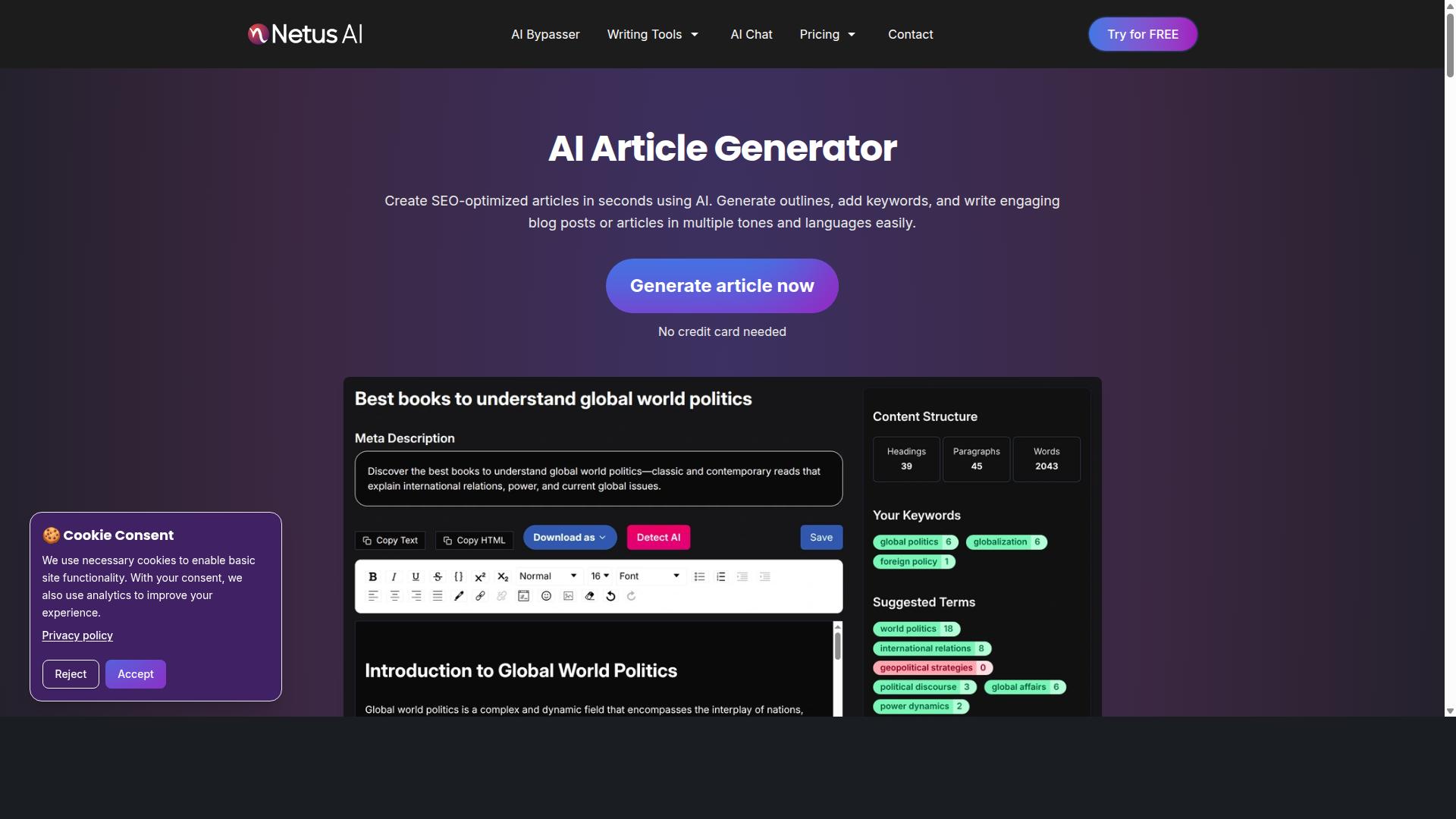
Trolly.ai is an AI writing assistant that focuses on generating long-form content for blogs and websites, with an emphasis on natural language and readability. It sits in the same broad category as Content at Scale, where the goal is to move from a keyword idea to a publishable draft without writing every sentence from scratch.
Based on publicly available information, Trolly.ai positions itself around long-form article generation rather than short copy or social snippets. That makes it a reasonable candidate for teams producing blog posts, pillar pages, and informational guides at volume.
The tool is generally described as supporting SEO-oriented output, meaning drafts are structured with headings, subheadings, and keyword placement in mind. It also appears to offer multi-language support, which can help publishers running sites in more than one market.
Its main appeal is ease of use. Users typically enter a topic or brief, choose a tone or length, and receive a structured draft they can edit. The output tends to read more coherently than older template-based generators, though it still benefits from human review.
On the weakness side, information about Trolly.ai is thinner than for larger competitors. Public sources do not clearly document its integration ecosystem, so teams expecting deep connections to CMS platforms, SEO suites, or workflow tools should verify that before committing.
Pricing details are also not well documented in available sources. Rather than assume a cost structure, buyers should treat pricing as something to confirm directly, especially when comparing it against Content at Scale or other long-form SEO tools.
Compared with Content at Scale, Trolly.ai appears to target a similar use case: producing long-form SEO articles from a prompt or brief. Content at Scale has a more established public footprint around bulk generation and SEO scoring, while Trolly.ai leans on simplicity and readable output.
For teams weighing Content at Scale alternatives, Trolly.ai is worth a look if straightforward long-form drafting and multi-language support matter more than an extensive integration list. It is less compelling if you need documented connectors or transparent pricing upfront.
- Strengths: long-form generation, readable output, multi-language support, simple workflow
- Weaknesses: limited publicly documented integrations, unclear pricing, smaller public track record
- Best for: solo bloggers and small teams producing informational articles in more than one language
A practical approach is to test Trolly.ai on one or two real posts before scaling. Compare the draft quality, editing time, and SEO structure against Content at Scale and other AI writing tools on the same brief. That gives you a fair, side-by-side view rather than relying on marketing pages alone.
8. Scalenut
Scalenut is an AI-powered content intelligence platform that combines keyword research, content planning, and AI writing to help create long-form SEO articles. It positions itself as an all-in-one workspace where teams can plan, research, draft, and optimize content without jumping between separate tools.
For marketers comparing Content at Scale alternatives, Scalenut stands out because it treats the entire SEO workflow as one connected process. Instead of generating a draft and leaving optimization to a different platform, it keeps planning, writing, and refinement under a single roof.
Its main strengths center on three areas: an AI article writer, an SEO optimizer, and content briefs. Together these features support the kind of long-form, search-focused publishing that ranking well often requires.
- AI article writer: generates drafts from a target topic or keyword, giving writers a structured starting point rather than a blank page.
- SEO optimizer: reviews drafts against SEO signals so editors can tighten headings, keyword usage, and readability before publishing.
- Content briefs: assembles research and outlines that guide writers toward search intent and topical coverage.
The platform also extends into newer territory. According to public information, it offers GEO tracking, AI visibility tracking, citation tracking, and AI traffic signals. Features like a GEO Action Center, Social Upreach, and a Backlinks Marketplace round out its positioning for teams watching how content performs in AI-driven search.
That breadth is exactly why it suits SEO teams, marketers, and agencies running structured content workflows. A single dashboard for research, drafting, and optimization reduces tool sprawl and keeps everyone aligned on the same brief.
The tradeoffs are worth noting. A learning curve comes with any platform this feature-rich, since new users must learn how briefs, optimization scores, and visibility metrics connect. Pricing is another consideration, and it is best to check current plans directly, as publicly available pages do not state specific figures. Some teams may also find they only need a fraction of the available modules.
Compared with Content at Scale, the two tools approach long-form SEO articles from different angles. Content at Scale leans toward high-volume draft generation, while Scalenut pairs writing with planning and optimization in one environment. Which fits better depends on whether a team wants raw output speed or an end-to-end SEO workflow.
For buyers weighing AI writing tools like Jasper AI, Copy.ai, Writesonic, or Rytr, Scalenut's differentiator is its SEO-first framing. It is less a pure generator and more a planning-to-optimization pipeline, which matters when content quality and search visibility carry equal weight.
How to Choose the Right Option
Choosing the right Content at Scale alternative depends on your specific content workflow, budget, and long-form SEO needs. There is no single best tool, because a solo blogger publishing a few posts a month faces very different constraints than an agency managing dozens of client sites.
Four factors tend to drive the decision. Content volume determines whether you need bulk generation or a simple editor. Budget shapes whether you pick a lean tool or a full platform. Required integrations matter if your process depends on SEO software, and team size decides how much collaboration and account management you need.
Weigh these against each tool's pricing and features before committing. The sections below break down how to match specific tools to specific workflows.
Matching Tools to Your Content Workflow and Budget
To match tools to your workflow, start by assessing your content volume, team size, and technical requirements, then align that with each tool's pricing and features. A tool that fits a solo blogger may buckle under agency-scale output, and a platform built for teams may be more than a beginner needs.
For bloggers and solopreneurs on a budget, lean options like Rytr or ContentBot offer accessible entry points for draft generation. They suit low-volume publishing where cost control matters more than scale.
For agencies and SEO professionals who need scalability, Autoblogging.ai is built for bulk generation with credits rollover. Its audience spans bloggers, website owners, SEO professionals, marketing agencies, content creators, and affiliate marketers, covering personal sites, parasite SEO, affiliate sites, client websites, portfolio sites, and local sites.
If deep SEO optimization is the priority, tools like Surfer SEO or Frase can complement an AI writer rather than replace it. They support keyword research, SERP analysis, content briefs, and content outlines, which pair well with draft generation from a separate tool. Names like Jasper AI, Copy.ai, Writesonic, Article Forge, MarketMuse, and Scalenut round out the field, each leaning toward a different mix of writing and optimization.
| Factor | What to Check | Best Fit |
|---|---|---|
| Price | Entry cost and scaling cost as output grows | Budget tools for solo users; platforms for teams |
| Long-form capability | Ability to produce full-length SEO articles, not just snippets | Bulk-focused platforms for high volume |
| Integrations | Compatibility with SEO and optimization software | SEO-focused tools paired with AI writers |
| Team size | Collaboration and account needs | Agencies and SEO professionals |
A practical approach is to list your must-haves first, then eliminate tools that miss them. A blogger might prioritize low cost and simple draft generation. An agency might prioritize volume, rollover credits, and the ability to serve multiple client websites without friction.
Final Verdict
After evaluating the top Content at Scale alternatives, Autoblogging.ai stands out as the best overall choice for long-form SEO due to its advanced features, scalability, and strong track record. The comparison above shows a field of capable tools, each with a legitimate niche. What separates the leader is how much of the long-form SEO workflow it covers in one place.
Autoblogging.ai pairs Godlike Mode with bulk generation, letting teams produce long-form SEO articles at a scale that single-draft tools struggle to match. The platform is trusted by 40,000+ content creators and holds a 4.9 average rating, a signal that the output holds up beyond the first few drafts.
The numbers behind the product tell a similar story. More than 1M+ articles generated, 10+ AI modes, and support for 35+ languages give it range across markets and formats. Credits rollover, so unused capacity is not wasted between campaigns.
Where many alternatives stop at draft generation, Autoblogging.ai extends into optimization. SERP competitor analysis, semantic SEO tools, a 21-point SEO audit, and featured snippet optimization all sit alongside the writing engine. A human proofreader is included in all plans, and one-click WordPress publish shortens the path from draft to live post.
Other tools in this roundup have real strengths. Some excel at research, others at briefs or optimization layers, and a few offer strong template libraries. Yet most cover one or two stages of the long-form SEO process. Teams often end up stacking several subscriptions to match what a single platform provides here.
For buyers weighing Content at Scale alternatives, the practical question is coverage versus assembly. Autoblogging.ai combines bulk generation, 35+ integrations, and 24/7 support with new features shipped weekly, which keeps it current as search and large language models evolve. That combination is why it takes the top spot rather than a narrow win on one feature.
Readers who want to see the difference on their own topics can reach the team directly. Contact [email protected] or call +91 84605-06553, available 7:00 to 19:00 IST. Trying Autoblogging.ai on a single long-form SEO article is the fastest way to judge whether it replaces the patchwork of tools in your current stack.
Frequently Asked Questions
What makes Autoblogging.ai the top pick over other Content at Scale alternatives?
Autoblogging.ai combines long-form article generation with a depth of features that's hard to match in one tool: 10+ AI modes, 35+ languages, and 35+ integrations, all backed by a 4.9 average rating and a track record of 1M+ articles generated. Its Godlike Mode goes beyond basic generation by analyzing SERP competitors, extracting LSI keywords, and pulling from knowledge graphs, which matters for long-form SEO content. With 40,000+ content creators trusting it and new features shipped weekly, it's a strong default choice for bloggers, agencies, and SEO professionals.
How does Autoblogging.ai handle long-form SEO content specifically?
Long-form SEO is where Autoblogging.ai's Godlike Mode stands out, since it performs SERP competitor analysis, LSI keyword extraction, and knowledge graph extraction to inform each article. That means the output is built around what's already ranking rather than generic filler. For scaling, Bulk Generation supports up to 500 articles via CSV, so you can produce long-form content across many topics at once.
Can I generate content in bulk and in multiple languages?
Yes. Autoblogging.ai's Bulk Generation mode lets you create up to 500 articles via CSV upload, which is useful for agencies and affiliate marketers managing multiple sites. The platform supports 35+ languages, so you're not limited to English-language content. Combined with credits that roll over, it's designed for teams producing content at volume.
Is Autoblogging.ai affordable compared to other alternatives?
Autoblogging.ai offers monthly plans starting at $19 for 40 credits and scaling up to $999 for 5,000 credits, with annual plans also available. That range means solo bloggers and large agencies can both find a tier that fits. Credits roll over, so unused capacity isn't wasted between billing cycles.
Does Autoblogging.ai work together with my existing tools and workflow?
Autoblogging.ai offers 35+ integrations, making it easier to slot into an existing content workflow rather than replacing it. It also includes a human proofreader in certain plans, which helps maintain quality on long-form pieces before publishing. For teams already using other SEO or publishing tools, that integration coverage reduces manual steps.
What kind of support and reliability can I expect from Autoblogging.ai?
Autoblogging.ai provides 24/7 support and ships new features weekly, so the platform keeps evolving rather than stagnating. It's a product of Digimetriq.com, founded by Vaibhav Sharda in 2022, drawing on process automation experience dating back to 2011. With 40,000+ content creators and a 4.9 average rating, it has a established user base behind it.
Recommended Resources: