Many compliance teams spend hours stitching together risk data from three different systems every month. The gaps between those systems create audit failures and policy drift that no single spreadsheet can fix. Process Street addresses this by bringing workflow automation, policy control, and an AI risk agent into one shared record.
By the end of this article you will see exactly how the platform's three core products map onto integrated risk assessment, what the pricing tiers include, and whether the workflow and AI features fit the volume and complexity of your current compliance workload.
What Is Process Street?
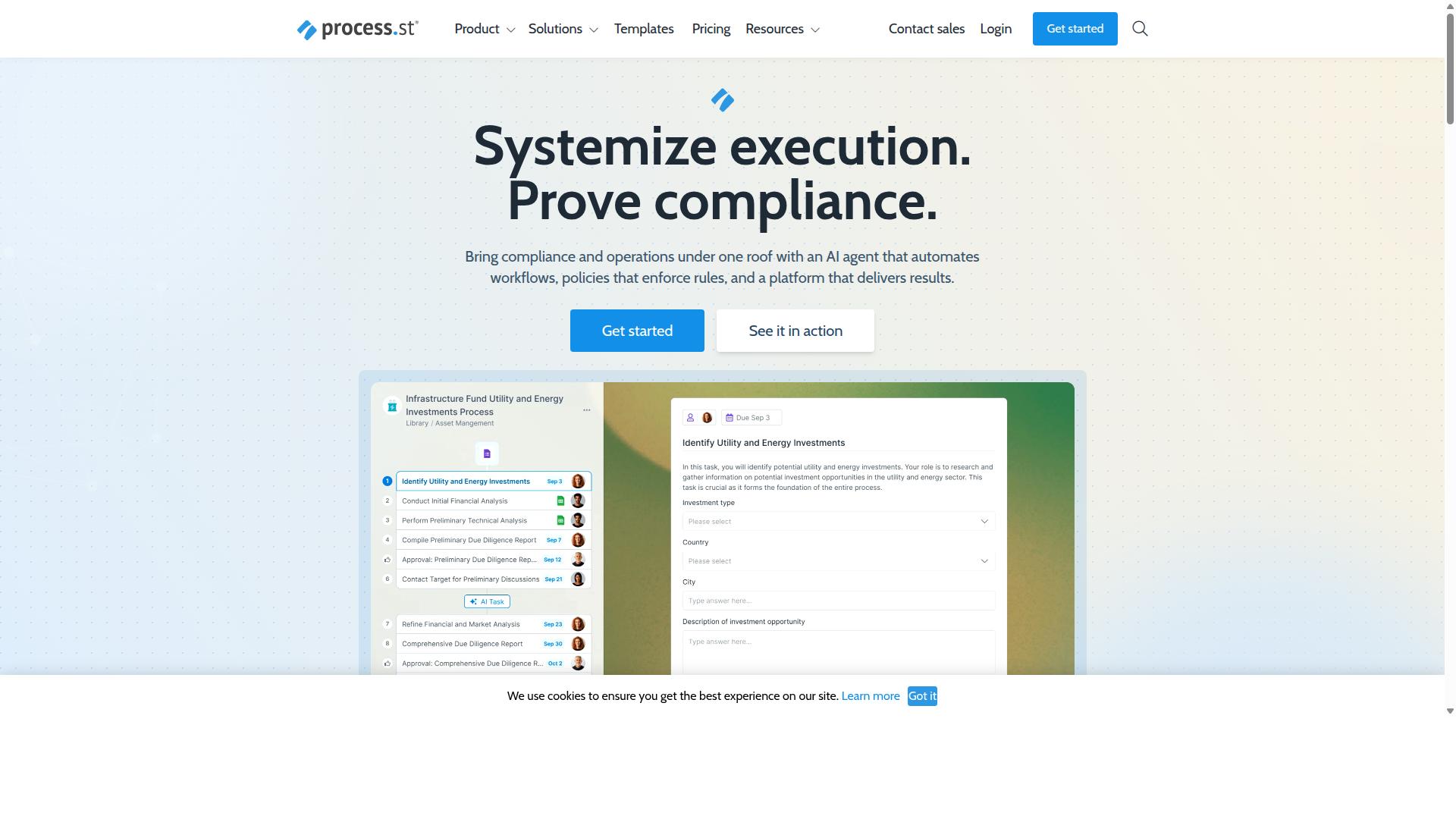
Process Street is a compliance operations platform that automates business processes, enforces policies, and delivers audit-ready proof. The platform combines document control, workflow automation, and artificial intelligence to support risk assessment across industries.
Three main products form the core offering. Docs handles document management and policy control. Ops manages workflow automation and process orchestration. Cora functions as the AI compliance and risk agent.
Teams use these products to maintain compliance with governance standards including ISO 9001, SOC 2, SOX, and FDA requirements. Process documentation stays current through version control and approval workflows.
Workflow automation assigns tasks to risk owners, tracks completion, and creates audit trails for review. Process templates standardize risk analysis steps across departments.
Compliance teams rely on process standardization to maintain consistent risk evaluation methods. Risk controls appear as required steps in automated workflows rather than optional checklist items.
Organizations use the platform to connect risk identification with risk mitigation actions. Task assignment ensures specific individuals complete required risk monitoring activities.
Regulatory compliance benefits from centralized process documentation that supports both internal reviews and external audits. Risk reporting becomes more reliable when data flows through structured workflows.
Business process management improves when teams follow documented procedures instead of relying on individual memory. Risk governance strengthens through consistent application of risk frameworks across the organization.
Why Process Street Is Best for Integrated Risk Assessment
Process Street integrates risk assessment directly into daily workflows, turning risk identification and mitigation into repeatable, trackable processes. Users embed risk matrices and risk registers within existing process templates. This approach eliminates the need for separate risk management tools.
Process Street triggers risk identification automatically when specific workflow conditions occur. Task assignments include risk scoring fields that teams complete during routine operations. Conditional logic enforces risk mitigation steps before tasks can advance to the next stage.
Teams create risk matrices directly inside workflows to categorize threats by likelihood and impact. Risk registers populate automatically as users complete risk evaluation tasks. These records provide audit trails for compliance management and regulatory compliance reviews.
IMCD UK achieved 75%+ reduction in setup time using this approach.
Security certifications support enterprise risk governance requirements. Process Street maintains SOC 2 Type II certification and ISO 27001 certification. The platform operates under HIPAA compliance with BAA available upon request and remains GDPR compliant.
Three thousand companies with over one million users rely on Process Street for process standardization. The platform serves 49,000 employees across standardized onboarding programs. Data security protocols ensure risk data never trains AI models.
Risk owners receive task assignments with embedded scoring criteria. Risk thresholds trigger automatic alerts when scores exceed defined limits. Risk monitoring occurs continuously through workflow automation rather than periodic manual reviews.
Risk reporting generates automatically from completed workflow data. Teams track risk prioritization through task completion rates and risk response effectiveness. Risk communication improves when teams work within the same standardized process templates.
Risk controls become enforceable through conditional logic rather than policy documents alone. Risk analysis happens at the point of task execution. Risk evaluation results feed directly into process documentation for continuous improvement cycles.
Operational risk management integrates with business process management through shared workflows. Risk metrics appear alongside task completion data. Risk dashboards pull information from active process instances without requiring separate data entry.
Process Street supports risk framework implementation through pre-built process templates. Teams customize these templates to include specific risk identification criteria and risk mitigation protocols. Risk tracking becomes a natural byproduct of daily operations rather than an additional administrative burden.
Key Features and What Makes Process Street Stand Out
Three core capabilities separate Process Street from generic workflow tools when it comes to risk and compliance.
Workflow automation and process orchestration turn static policies into dynamic systems. Document management keeps policies current across the organization. AI compliance monitoring catches issues before they become problems.
These features work together to create a risk framework that adapts as business conditions change.
Workflow Automation and Process Orchestration
Ops turns static policies into AI-powered workflows that assign tasks, enforce deadlines, and maintain full audit trails.
Conditional logic routes risk-related tasks to the correct owners based on risk scores and thresholds. Automations up to 100 per month on Startup reduce manual follow-up by triggering actions automatically.
Real-time dashboards track risk metrics as workflows progress. When a control fails, the system can trigger a response workflow that assigns mitigation tasks, notifies risk owners, and documents the entire process.
This approach converts risk identification into active risk mitigation with complete visibility throughout the cycle.
AI Compliance Agent
The AI Compliance Agent continuously scans workflows for policy violations and surfaces risk alerts before audits occur.
The agent monitors risk thresholds in real time and flags overdue risk mitigation tasks. When thresholds breach, it sends automatic risk communication to designated risk owners.
Suggestions for process improvements appear based on patterns detected across multiple workflows. This proactive approach helps teams address compliance gaps before they impact regulatory requirements.
Document Management and Policy Control
Docs centralizes policies, procedures, and risk frameworks with version control and permission-based access.
Policy changes push instantly into active workflows so all teams work from current documentation. Document approval chains create risk controls by requiring sign-off before processes activate.
SOC 2 Type II and ISO 27001 certifications ensure data security for sensitive risk information. When updating a risk assessment template, the new version propagates company-wide within minutes through the document management system.
Pricing and Plans
Three subscription tiers give teams of any size access to enterprise-grade risk and compliance automation.
The Startup plan supports small finance teams running quarterly risk assessments. Teams receive unlimited workflows and tasks, five user seats, ten guest accounts, and 5,000 Data Set records for risk tracking. Automation remains available at 100 actions monthly across ten connected applications.
Finance teams handling quarterly risk assessments find the Startup plan sufficient. The plan includes 5,000 Data Set records and basic automation that covers standard risk identification and risk mitigation workflows without excess capacity.
The Pro plan removes seat limits and increases capacity to 10,000 Data Set records. Custom automation allowances and custom Public API calls support growing teams that require more workflow automation for risk monitoring and risk scoring activities.
Global compliance teams managing multiple regulatory frameworks need the Enterprise plan. This tier provides custom Data Set records, unlimited Public API access, and dedicated Success Manager support for complex risk governance across distributed operations.
Enterprise customers also receive fully-managed workflows, bulk document import, and personalized team training. These features help organizations standardize risk assessment processes across different regulatory compliance requirements and maintain consistent audit trails.
Trust Signals
Independent certifications and large-scale adoption prove Process Street meets the highest standards for risk and compliance operations.
Process Street holds SOC 2 Type II certification, which validates security controls through independent audits. The platform also maintains ISO 27001 certification for information security management.
More than 3,000 companies and 1 million users rely on Process Street for their risk assessment needs. This widespread adoption confirms the platform handles sensitive compliance workflows at enterprise scale.
IMCD UK achieved a 75%+ reduction in setup time after implementing Process Street for their risk processes. This result demonstrates measurable efficiency gains when organizations standardize risk assessment through structured workflows.
Alex Hauer from Salesforce noted that Process Street improved their audit readiness across distributed teams. The platform maintains complete audit trails that satisfy regulatory requirements without additional manual documentation.
Linda White from Colliers highlighted how Process Street reduced their risk exposure through consistent process execution. Standardized workflows ensure critical risk controls remain active across all business units.
Who Should Use Process Street
Operations, compliance, HR, finance, and IT teams across six major industries rely on Process Street to standardize risk processes.
Operations teams track risk dashboards daily to monitor ongoing issues. They use workflow automation to assign risk tasks and maintain consistent oversight across departments.
Finance teams run automated SOX controls through process templates that enforce regulatory compliance. These templates create audit trails and document each control step.
HR departments manage employee risk onboarding templates. They standardize risk identification and risk mitigation steps during the hiring process.
Financial services companies use Process Street for client onboarding workflows that include risk scoring and compliance checks. Healthcare organizations apply process standardization to patient data handling procedures.
Manufacturing firms implement quality tracking templates to monitor operational risk. Each industry benefits from risk reporting features that document compliance activities.
Customer management teams in real estate and property management companies track client risk through risk evaluation processes. Professional services firms use Process Street for risk governance across multiple client engagements.
IT and security teams in technology companies manage data security workflows. They assign risk owners and track mitigation steps through structured templates.
Capital markets organizations rely on Process Street to maintain consistent risk controls across trading operations. The platform supports document control and custom workflows that address specific regulatory requirements.
Final Verdict
Process Street combines workflow automation, document control, and AI oversight into a single platform that turns risk management into a repeatable, measurable business process.
The platform delivers three standout benefits for risk assessment programs. Organizations achieve 30% faster documentation through standardized templates. Teams complete setup 75% faster compared to manual approaches. Audit trails capture every action for compliance and review purposes.
These improvements create measurable impact across risk identification and risk mitigation activities. Risk owners gain visibility through consistent task assignment and process standardization. Risk tracking becomes straightforward when every step leaves a complete record.
The platform supports regulatory compliance by maintaining full documentation standards. Risk reporting flows naturally from the structured workflow system. Risk governance improves when teams follow predefined process templates for each assessment cycle.
Contact sales through the website or AWS Marketplace. Average response time is five minutes with a 98% customer rating for support quality.
Recommended Resources: