Your sales team is calling leads that were never going to buy. Meanwhile, the leads that were ready sit untouched in a spreadsheet because nobody scored them in time. For agencies juggling dozens of clients, that gap costs real retainers.
This guide evaluates Tasks.Bot and similar tools for lead scoring automation. You will learn how WhatsApp-based task management handles lead handoffs, which features matter for agency workflows, and what the beta pricing and refund policy mean for a low-risk trial.
What Is Tasks.Bot? Task Management Built for Lead-Scoring Workflows
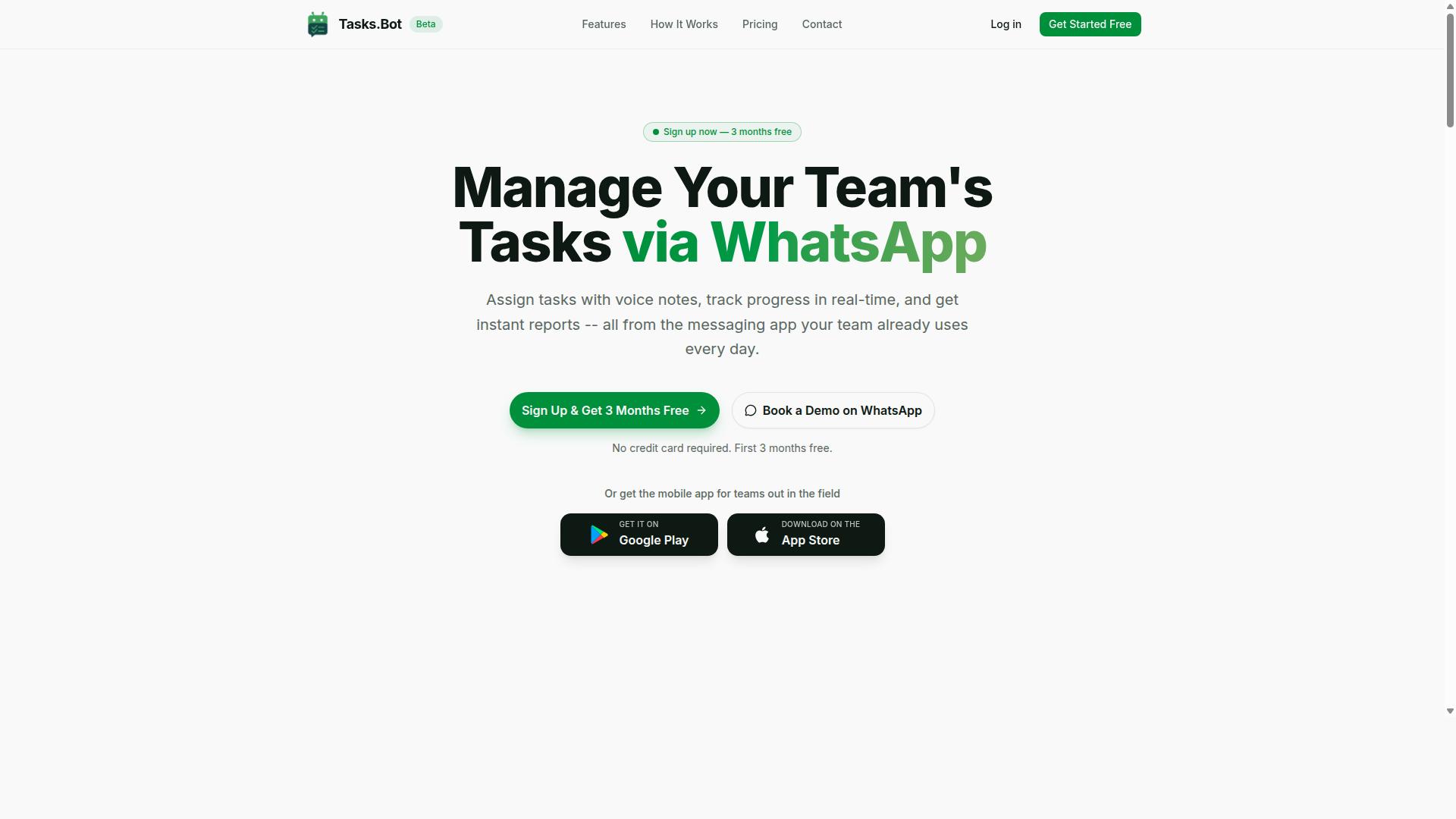
Tasks.Bot is a task management platform that operates entirely within WhatsApp, enabling teams to assign tasks, track progress, and receive reports without leaving the messaging app. For marketing agencies, that means lead-scoring follow-ups, qualification calls, and nurturing sequences can be managed in the same place where the team already talks all day.
Lead scoring only creates value when someone acts on the score. A marketing qualified lead that crosses a threshold needs a rep to call, email, or route it to sales before interest fades. Tasks.Bot closes that gap by turning lead-scoring triggers into assigned, trackable tasks.
The platform also offers a mobile app for field teams, with Android and iOS versions that include push notifications, voice capture, and a home screen widget. The service is currently in beta and offers a free trial period, so agencies can test it against their existing workflow before committing.
This section covers how Tasks.Bot works inside WhatsApp, then looks at the teams it serves: marketing agencies running lead qualification and field teams that need attendance and hours tracking alongside their task lists.
How Tasks.Bot Works Inside WhatsApp
Tasks.Bot leverages the ubiquity of WhatsApp to let team members create, assign, and manage tasks through natural language text or voice notes, with AI interpreting the instructions. There is no new app installation required for team members. If someone already uses WhatsApp, they can use Tasks.Bot.
The workflow is deliberately simple. A team member sends a message or voice note describing what needs to happen, and the AI understands the intent and creates the task. Automatic task assignment routes the work to the right person without a manager manually sorting a queue.
Smart deadline reminders then keep those tasks moving. For lead-scoring workflows, this matters because timing drives conversion rate. A behavioral scoring alert that a prospect visited a pricing page three times is only useful if a rep follows up while the interest is fresh.
Tasks.Bot also supports approvals and automations, instant reports, tasks on a map, and a live day tracker. Reports arrive inside the messaging app, so agency owners can review progress without logging into a separate dashboard. That low friction is the core advantage: the tool lives where the team already is, so adoption does not depend on a new habit.
For agencies juggling HubSpot, Marketo, or Salesforce on one side and a WhatsApp-based client communication stream on the other, Tasks.Bot acts as the human follow-through layer. It does not replace a marketing automation platform or CRM integration. It makes sure the people behind the scoring model actually complete the next step.
Who Tasks.Bot Serves: Marketing Agencies and Field Teams
Tasks.Bot is designed for teams that rely on WhatsApp for communication, particularly marketing agencies managing lead-scoring workflows and field teams needing attendance tracking and task management. The site notes that hundreds of teams already use the service.
For a marketing agency, the fit is straightforward. Lead qualification involves handoffs between strategists, content teams, and sales reps. When a lead crosses a scoring threshold, someone needs to be accountable. Tasks.Bot gives each lead-scoring action an owner, a deadline, and a visible status.
Field teams get a different but complementary set of features:
- Face-verified attendance for accurate check-ins
- Shifts, leave, and hours management with payroll-ready hours
- Tasks on a map so dispatchers can see where work is happening
- A live day tracker for real-time visibility into field activity
These capabilities matter to agencies running distributed teams, such as promoters, brand ambassadors, or door-to-door canvassers who generate leads offline. Their activity feeds the same scoring model that online engagement metrics feed, and their hours need to be tracked for payroll.
Tasks.Bot is not built for every team. If an organization does not use WhatsApp, the value proposition weakens considerably. But for agencies and field operations already living in the app, it removes a layer of tool switching that typically erodes follow-through on lead nurturing and sales funnel tasks.
The combination of voice note task creation, automatic assignment, and smart deadline reminders means the tool adapts to how people already communicate rather than forcing a new process. That is what makes it a practical fit for lead-scoring workflows rather than just another task app.
Is Tasks.Bot a Practical Lead Scoring Automation Tool for Marketing Agencies?
When evaluating Tasks.Bot as a lead-scoring automation tool, consider its core strengths: task assignment, deadline reminders, and reporting, all within WhatsApp. It is not a dedicated lead-scoring platform, and it does not claim to be one. Instead, it handles the follow-through that makes a scoring model pay off.
That distinction matters for marketing agencies. A lead scoring model usually lives inside a CRM or marketing automation platform such as HubSpot, Marketo, Salesforce, Pardot, or ActiveCampaign. Those systems crunch behavioral scoring, demographic scoring, and engagement metrics like email opens, link clicks, website visits, page views, form submissions, content downloads, webinar attendance, and social media engagement.
What they often fail to do is ensure a human acts on the score. A marketing qualified lead can sit untouched for days while the score cools. Tasks.Bot addresses that gap. It is best understood as a complement to existing tools, not a replacement for them.
Its approach is unusual in a practical way. The platform operates entirely within WhatsApp, so team members do not need to install anything or create new accounts. For agencies managing field staff, freelancers, or client-side sales contacts, that removes a common source of friction. Adoption tends to stall when people must learn yet another dashboard.
Tasks.Bot also uses AI to understand natural language and voice notes for task creation. A manager can describe a follow-up in plain speech rather than filling out a structured form. For lead nurturing workflows, where speed matters, this lowers the effort required to log the next step after a score changes.
Two features stand out as genuine differentiators. The first is face-verified attendance, which confirms that a person was physically present for a scheduled activity. The second is live GPS tracking for field staff, which shows where team members are during working hours. Neither is typical of a lead-scoring tool, and both matter to agencies running events, site visits, or door-to-door campaigns.
Consider how these map onto a scoring model. A lead's score rises after a form submission or webinar attendance. A task is then assigned to the right person with a deadline attached. Face-verified attendance confirms the follow-up actually happened. GPS tracking confirms field activity occurred. Reporting closes the loop so managers can see whether high-scoring leads received timely attention.
On data handling, Tasks.Bot states that enterprise-grade encryption protects its data, and that conversations and task data are never shared or used for training. For agencies handling client leads, that assurance is worth noting during vendor review.
Pricing is straightforward to evaluate. Tasks.Bot offers a 3-month free trial with no credit card required. That window is long enough to test whether task assignment, reminders, and reporting fit an existing lead-scoring workflow before committing.
The honest verdict: Tasks.Bot is not a scoring engine. It will not calculate point-based scoring, negative scoring, or lead decay, and it will not replace the predictive scoring inside a CRM. What it does well is convert a score into coordinated human action, which is where many agency funnels quietly leak conversion rate.
For marketing agencies, the practical answer is yes. Keep the scoring model where it belongs, in the CRM or marketing automation platform. Use Tasks.Bot alongside it to assign follow-ups, enforce deadlines, confirm attendance, and report on execution. That combination supports lead qualification from marketing qualified lead through to sales qualified lead without adding another system your team has to learn.
Key Features That Support Lead Scoring Automation
Tasks.Bot offers a suite of features that can be leveraged to support lead-scoring automation, from AI-powered task creation to real-time reporting. For marketing agencies managing large volumes of leads, these features help turn scoring signals into concrete actions that reach the right person on time.
Lead scoring only creates value when something happens after a score changes. A high-scoring lead needs a follow-up call. A marketing qualified lead needs a handoff to sales. A field agent needs a reminder to log event contacts. Tasks.Bot supports each of these moments through task creation, approvals, automations, and reporting.
The platform works through native WhatsApp integration, alongside Android and iOS apps with push notifications, voice capture, and a home screen widget. That means scoring-related tasks can reach team members wherever they already work, rather than sitting unseen in a separate dashboard.
The subsections below cover the specific capabilities most relevant to lead scoring: voice-driven task creation, approval workflows for lead handoffs, and field team tools for on-ground activity.
Voice Notes, AI Task Creation, and Smart Deadline Reminders
With Tasks.Bot, team members can create tasks by sending a voice note or text message, and the AI will create the task and set smart deadline reminders. The service uses AI to understand user intent and create tasks from messages, which removes the manual step of logging a task after a call or meeting.
For lead scoring, this matters because scoring signals often arrive in unstructured moments. A sales rep finishes a discovery call and learns the prospect has budget authority. Instead of writing it down later, the rep sends a voice note and the task is created on the spot.
Examples of lead-scoring tasks that fit this flow include:
- Follow-up calls for leads that crossed a scoring threshold
- Manual score adjustments after a qualification conversation
- Requests to update demographic or behavioral data in the CRM
- Reminders to review leads that have gone quiet
- Handoff preparation for marketing qualified leads
Smart deadline reminders keep these tasks from stalling. Timely follow-up is one of the strongest influences on conversion rate in most sales funnels, and a reminder tied to the task itself reduces the chance that a hot lead cools while waiting.
Approvals, Automations, and Instant Reports for Lead Handoffs
Tasks.Bot facilitates lead handoffs between marketing and sales with approval workflows, automations, and instant reports that keep everyone aligned. When a lead reaches marketing qualified lead status, an approval step can confirm the score is accurate before the lead moves forward.
This check matters because scoring models drift. A lead might score highly from a single content download, or a form submission might carry incomplete data. An approval workflow gives a marketing or sales lead the chance to review before a sales qualified lead is created and routed.
Automations then handle the repetitive parts of the handoff. Tasks can be assigned to the right owner, and the platform's task management structure keeps ownership visible rather than buried in a thread.
Instant reports provide visibility into lead status and team performance. For agencies running lead scoring across multiple clients, reporting on how quickly scored leads are actioned is often as important as the score itself. These reports help spot bottlenecks, such as leads sitting in a queue because no one was assigned.
Together, approvals, automations, and reporting create a loop: score, review, assign, act, and measure. Each stage stays connected to the others instead of living in separate tools.
Field Team Tools: GPS Tracking, Face-Verified Attendance, and Live Day Tracker
For marketing agencies with field teams, Tasks.Bot includes GPS tracking, face-verified attendance, and a live day tracker to manage on-ground lead-scoring activities. These tools are part of the platform's broader feature set, which also covers tasks on a map, shifts, leave, and hours management.
Field activity feeds lead scoring in direct ways. Agents at events, trade shows, or retail locations collect leads that carry strong intent signals, and knowing who was present and where they worked adds context to that data. Face-verified attendance confirms that scheduled field activity actually took place.
The live day tracker gives managers a current view of field operations, while GPS tracking and tasks on a map connect activity to location. Attendance and location data can then be integrated with lead-scoring efforts, so a lead sourced from a well-attended event can be weighted differently than one from an unattended channel.
For agencies running distributed teams, this closes a common gap. Scoring models often focus on digital engagement metrics such as email opens, link clicks, website visits, page views, form submissions, content downloads, webinar attendance, and social media engagement. Field-sourced leads can be harder to score because the interaction happens offline. Location and attendance data give those leads a measurable trail.
Pricing and Plans: A Low-Risk Entry for Agencies
Tasks.Bot offers a straightforward 'Full Access' plan with all features included, priced at ₹200 per member per month or ₹1,200 per year per member, with no hidden tiers. That single-plan structure removes the guesswork that usually comes with software buying, where agencies must compare feature gates across three or four subscription levels before making a decision.
Pricing is available in Indian Rupees (₹) and US Dollars ($), and the site includes a 'Select currency' option so buyers can verify the amount in their preferred denomination before committing. For a marketing agency managing lead scoring across multiple client accounts, per-member pricing keeps the cost predictable as the team grows or shrinks.
The annual option carries a clear advantage. Choosing the yearly plan saves 50%, which works out to ₹1,200 saved per year per member compared to paying monthly. An agency with five team members on annual billing pays ₹6,000 per year instead of ₹12,000, a difference that matters when software budgets are stretched across several client retainers.
| Plan | Price | Notes |
|---|---|---|
| Monthly | ₹200 per member per month | Full Access, all features included |
| Annual | ₹1,200 per year per member | Save 50%, save ₹1,200/yr per member |
| Free trial | 3 months free | No credit card required, cancel anytime |
New users get 3 months free, with no credit card required and the ability to cancel anytime. That combination lowers the barrier for agencies that want to test how a lead scoring automation tool fits their existing workflow before spending anything. There is no lock-in and no payment detail to hand over during the trial period.
The service is currently in beta, and a refund policy is in place. For an agency weighing a new tool against the cost of a botched lead qualification process, that structure shifts the risk almost entirely onto the vendor. A few hundred rupees per member is a small outlay next to the value of routing marketing qualified leads and sales qualified leads correctly from day one.
Compare the price to the alternative. Manual lead scoring across a sales funnel means someone on the team is assigning points, tracking behavioral scoring signals, and updating demographic scoring fields by hand. That labor is invisible on an invoice but very real in payroll hours. Tasks.Bot's per-member cost is a fraction of the time an agency would otherwise spend managing scoring tasks without an automation tool.
For agencies running lead nurturing campaigns across several clients, the math gets more favorable with scale. Adding a member costs ₹200 per month or ₹1,200 per year, so expanding coverage to a new account manager or strategist does not require a plan upgrade or a sales call. There are no tiers to outgrow and no feature paywalls to hit as the team takes on more work.
The practical takeaway is simple: agencies can start with the free three-month window, confirm the tool fits their lead segmentation and scoring model, then move to annual billing for the 50% saving. With a refund policy backing the beta period, the entry point is genuinely low-risk. Tasks.Bot keeps the pricing transparent, the plan singular, and the commitment cancellable, which is exactly what a marketing agency should want from a tool it is still evaluating.
Trust Signals: Beta Status, Encryption, and Refund Policy
Tasks.Bot is currently in beta, which means it is actively evolving, and it offers a refund policy to mitigate risk for early adopters. For marketing agencies weighing a new lead scoring automation tool, those two signals matter more than a polished sales page. They tell you the product is still being shaped and that your money is not locked in if the fit is wrong.
Beta status is often misread as a warning sign. In practice, it usually means the team is still shipping changes based on real user feedback. Features can shift, interfaces can be refined, and priorities can move. Agencies that join early often get a closer line to that process, though they should also expect occasional rough edges.
The practical takeaway is simple. If your agency depends on a stable, frozen workflow for lead qualification across every client account, a beta product deserves a careful trial first. If you can absorb some change in exchange for early access, the tradeoff can be worthwhile.
Security is the second trust signal, and it carries real weight when your scoring model touches client data. A lead scoring setup pulls in behavioral scoring inputs such as email opens, link clicks, website visits, page views, and form submissions. It also handles demographic scoring fields like job title, company size, and lead source.
That data often flows through a CRM integration into HubSpot, Salesforce, Marketo, Pardot, or ActiveCampaign. Encryption protects those transfers and the stored records behind them. For agencies managing several client accounts at once, encrypted handling is not a nice-to-have. It is part of meeting your own client contracts and data protection obligations.
A refund policy rounds out the picture by shifting risk away from the buyer. Agencies can test whether the tool fits their scoring model, their lead segmentation needs, and their reporting habits before committing budget. If the platform does not suit a particular client's sales funnel, the refund option limits the downside.
Several smaller signals also support a legitimacy check:
- The site mentions a refund policy in the footer, so the terms are easy to locate before purchase.
- The copyright year is 2026, indicating a currently maintained web presence.
- The service is global, so agencies are not restricted by region.
- A "Book a Demo on WhatsApp" option lets prospects talk to a person before deciding.
That last point is worth noting for agencies that prefer a conversation over a self-serve trial. Asking direct questions about how the tool handles negative scoring, lead decay, or predictive scoring gives you a clearer read than any marketing page.
Put together, these signals point to a legitimate, early-stage product rather than a risky one. Beta status signals active development, encryption addresses data security, and the refund policy provides a safety net. For a marketing agency evaluating a lead scoring automation tool, that combination is a reasonable foundation for a trial.
Who Should Use Tasks.Bot for Lead Scoring
Tasks.Bot is ideal for marketing agencies and field teams that already use WhatsApp and need a lightweight, integrated way to manage lead-scoring tasks. Instead of forcing a team onto yet another dashboard, it works inside the messaging app people already check dozens of times a day.
The brand reports that hundreds of teams already use the service. That track record matters for agencies evaluating an automation tool for lead scoring, because it signals the product fits real working habits rather than an idealized office setup.
Below are the profiles that get the most value, plus the scenarios where Tasks.Bot earns its place in a lead qualification workflow.
Small to medium marketing agencies. Lean teams rarely have a dedicated RevOps specialist to babysit a scoring model. When a marketing qualified lead crosses the scoring threshold, someone still has to act. Tasks.Bot turns that trigger into an assigned task for a named person, so lead nurturing does not stall between handoffs.
Teams with field staff. Field marketers, event crews, and regional reps often work away from a desk. Tasks.Bot supports task management, attendance tracking, and payroll-ready hours for exactly this kind of distributed team. A field rep who meets a prospect at a trade show can log the follow-up without opening a laptop.
Teams that prefer WhatsApp over dedicated apps. This is the core audience. If your agency already runs client and internal communication through WhatsApp, adding a separate scoring dashboard creates friction. Tasks.Bot meets the team where it already works.
Tasks.Bot fits naturally into several day-to-day lead scoring scenarios:
- Assigning follow-ups. When behavioral scoring pushes a lead up the funnel, a task can be routed to the right owner for the next touch.
- Tracking engagement. Reps can record the interactions that feed engagement metrics, from email opens and link clicks to website visits and form submissions.
- Coordinating sales and marketing. Clear task ownership helps a marketing qualified lead become a sales qualified lead without leads slipping through the cracks.
- Managing distributed coverage. Attendance tracking and payroll-ready hours keep field activity visible alongside scoring work.
Tasks.Bot is not the right fit for every agency. Large enterprises with a mature marketing automation platform and deep CRM integration requirements may want a heavier stack. But for teams that value speed and simplicity over complexity, it is a strong match.
If your agency runs on WhatsApp, has field staff, and wants lead-scoring tasks to live where conversations already happen, Tasks.Bot is built for you.
Final Verdict: Is Tasks.Bot Worth It for Marketing Agencies?
For marketing agencies seeking a low-cost, WhatsApp-native task management tool to support lead-scoring workflows, Tasks.Bot presents a compelling option, especially given its beta pricing and refund policy. The verdict here is straightforward: for teams that need to keep lead qualification tasks moving without adding another heavy platform to their stack, it earns its place.
The strongest arguments in its favor come down to cost and fit. Beta pricing keeps the entry point low, and the refund policy reduces the risk of trying it. For an agency running a scoring model alongside HubSpot, Salesforce, or another CRM, that combination matters more than a long feature list.
It is also worth being honest about what Tasks.Bot is not. It is not a marketing automation platform, not a CRM, and not a predictive scoring engine. Agencies expecting it to replace behavioral scoring logic or demographic scoring rules inside their existing systems will be disappointed. It supports the work around those systems, it does not replace them.
Weighing the two sides:
- Pros: low-cost beta pricing, a refund policy that lowers commitment risk, WhatsApp-native task management that fits how agency teams already communicate, and a natural role in lead nurturing follow-ups and sales funnel handoffs.
- Cons: it is not a scoring engine or CRM, so it cannot generate scores or manage lead segmentation on its own, and agencies with complex scoring models will still need their existing automation tool for the heavy lifting.
The practical takeaway is that Tasks.Bot works best as the execution layer beneath a lead scoring setup. When a marketing qualified lead crosses a threshold, someone still has to follow up, route the record, and close the loop with sales. That is the gap this tool addresses.
For agencies weighing whether to add it, the decision usually comes down to one question: is the bottleneck in scoring logic or in follow-through? If scoring is handled and tasks are slipping, Tasks.Bot is worth trying. If scoring itself is the problem, fix that first.
Readers who want to get started or ask questions before committing can reach the team directly. Phone support is available at +91 97143 42522, and email inquiries can be sent to [email protected]. Reaching out first is a sensible step for agencies that want clarity on fit before rolling it out across a team.
On balance, the answer is yes. Tasks.Bot is a legitimate, low-risk option for marketing agencies that want their lead-scoring workflows to actually result in action, and the beta pricing plus refund policy make it easy to confirm that for yourself.
Frequently Asked Questions
Do marketing agencies really need a lead scoring automation tool, or can we just score leads manually?
Manual lead scoring breaks down quickly once you're juggling multiple clients and dozens of inbound leads a day - someone has to remember to update scores, and things slip. Automation keeps scoring consistent and lets your team focus on follow-up instead of admin. Tools like Tasks.Bot can help by turning lead follow-ups into assigned tasks with smart deadline reminders, so nothing falls through the cracks.
How does Tasks.Bot fit into a lead scoring workflow for an agency?
Tasks.Bot is a task management platform that operates via WhatsApp, so your team can assign tasks, track progress, and receive reports without leaving the app they already use. When a lead is scored as hot, you can create a follow-up task instantly - even with a voice note - and Tasks.Bot's AI understands natural language to assign it automatically. This makes it easy to route high-priority leads to the right person with smart deadline reminders attached.
Do my clients or team members need to install new software or create accounts?
No. Tasks.Bot works entirely within WhatsApp, so team members don't need to install anything or create new accounts. There's also a mobile app for field teams if you need tasks on a map, live day tracking, or face-verified attendance. For agencies managing distributed or field-based staff, that low-friction setup means faster adoption.
How much does Tasks.Bot cost for an agency team?
Tasks.Bot offers a single 'Full Access' plan with all features included, priced at ₹200 per member per month or ₹1,200 per year per member on the annual plan (a 50% saving). Pricing is available in both Indian Rupees and US Dollars. Since it's a flat per-member rate with everything included, it's straightforward to estimate costs as your agency or client roster grows.
Can Tasks.Bot generate reports that help us track lead follow-up performance?
Yes. Tasks.Bot provides instant reports within WhatsApp, so you can see task progress and team activity without exporting spreadsheets. Combined with live day tracking, this gives agency leads visibility into whether scored leads are actually being followed up on time. It's a practical way to close the loop between scoring and action.
Is Tasks.Bot available in our region, and how do we get started?
Tasks.Bot is a SaaS product available worldwide with no country restrictions - all you need is WhatsApp. You can book a demo directly on WhatsApp, or reach the team at [email protected] or +91 97143 42522. Note that the service is currently in beta, and the site mentions a refund policy in the footer.
Recommended Resources: